Monday, May 30, 2011

La semaine de la bicyclette

This week is 'Bike Week' or 'La semaine de la bicyclette' as you say in 'le français'.

Recently Nova Scotia has put forward a law, to be in effect as of June 1st, that all motorists give bicyclette's at least 1 metre of room at all times (check here for a summary of Bill 93).

Now I will admit that last year I had this strange love affair with bicycles, okay honestly I still adore them. But from a lazy person's perspective. I love the IDEA of bicyclettes; how they look, how cute and funky and laid back most bicyclette-ers appear, how NO gas fumes or carbon is spewed out for a trip.
Veronica in her winter 'home'
Last summer my friend Kevin found me the most beautiful bicyclette- a vintage 1970's, almost in perfect condition, Violette Bicyclette (anyone else remember that song?) whom I have named 'Veronica'. She now has a basket, a very cute 'dring dring' bell and a funky original leather seat.

She also weighs about a gazillion tons... Veronica is a big boned violette bicyclette.

I had no idea how her tonnage could have an impact on my riding skills. All summer long I wondered why everyone else was just coasting along, arriving to yoga in the park and hardly breaking a sweat and I was huffing and puffing trailing behind them. I mean, I couldn't be that out of shape right? Maybe I was just a terrible bicyclette rider.

Then... someone pointed out that I was really hauling Veronica's massive girth around with me.

Early fall last year poor Veronica obviously couldn't handle my extra weight and she busted an inner tube. She's been hanging out in our apartment entryway ever since.

Today, in honour of 'la semaine de la bicyclette' Andrew and I walked down to MEC and bought TWO inner tube tires. Unfortunately, as Veronica is a rare and mature specimen, the inner tube tires are also quite rare and unusual. I have no idea if they will fit... thank goodness our friends Jen and Chris are coming over to demonstrate how to change the tire (update: they fit! Although the lesson on changing was valuable, I am so glad Chris was there to help).

Tomorrow will be the second only 'Yoga in the Park' since the season started and I cannot wait. I am going to slug my way there, huffing and puffing, and enjoy a beautiful yoga practice while listening to the powerful waves of the Atlantic ocean.

How are you going to use your bicyclette this week?

Tuesday, May 24, 2011

Illicit Rooftop Gardening

Growing my own food- I strongly believe that in order to live sustainably we need to try to keep our food as local as possible. Personally, buying organic bananas that have been shipped thousands of miles to my plate doesn't sound very sustainable at all.

Although I know I can't personally grow a whole lot in an "urban" garden, I feel like a small container with real food growing is a contribution to changing the culture of what is considered "urban" and "rural" behaviour. That and my last three urban dreams have drifted down the bug infested, dead toilet.

 (Halifax Seaport Farmer's Market from upper level)

So I'm setting my standards low.

A problem with our current apartment, although a dream in a heritage building, there was no balcony. No growing space except for this ridiculous green patch which the exhaust fumes of the cars parked in the driveway spew onto. No fumigated food thank you very much.

At the end of last summer, though, I found out from my neighbour that she sunbathes on the roof... YES! that would be perfect- I would sneak up there with a container and make a rooftop garden.

 The beautiful peg and dowel garden box! It was a cinch to put together!

 A month ago I found a local farmer at the market who was selling these uber cool wooden peg and dowel garden boxes. He hand mills them and the wood is all Forest Stewardship Certified. After checking with my dad on price and whether it would cost less for him to make me some (haha, forever the fisherman's daughter)- no it wouldn't- I bought a small one. My favourite part? It will easily come apart for storage at the end of the season. In a Halifax heritage building, storage is treasured.

 The fire escape UP (and our living room window behind there) and DOWN...

Sunday, Andrew and I finally decided it was time to foray into the illicit rooftop garden world. Firstly; the neighbours. Our fire escape, the entrance to the roof, goes directly by two levels of windows. It was a perfect opportunity to meet a new third floor neighbour! We bought a bag of organic potting soil, some lettuce starters and hot peppers from the Farmer's Market (they're supposed to be easy to grow here in Nova Scotia) and pretty viola flowers. Just because.
The view from the roof!

Two trips up and we had everything on the roof. Unfortunately I hadn't counted on my fear of heights as something to consider. Those steps are narrow and steep and well... I really don't like being high up. Watering should become an adventure.

Another thing I hadn't considered once up there: just how beautiful our view was! We can see the Atlantic ocean from our roof. I had the sudden urge to practice yoga- which was sad since I'm *really* sure that would be frowned upon.
Our little planter! The beauty is the bag can stay, discouraging cats and bugs!

All planted up and a quick water later and tahdah! My very own tiny little urban garden box, complete with pretty flowers for some urban bees to snack on. Since it's rained today, I've only been up there to water and check on the little box once. We'll see how it turns out, but I am immensely proud of my own little food sustainable project. :)

Blessings!

Article and photographs copyright of EcoYogini at ecoyogini.blogspot.com

Saturday, May 21, 2011

How to meet your neighbours without looking like a dork

The concept of community and connection really does change depending on where you live. Since moving out, I have lived in apartments; either little square boxes in big huge buildings or basement apartments. It's pretty darn difficult to forge a community in an apartment building, especially compared to just how easy it can be in a rural setting. (I haven't ever lived in the suburbs, so no experience to compare there).

Something that often doesn't get discussed is the importance that community should play in helping us live a sustainable, Planet friendly life. During the mostly rant-forward talk last week on permaculture, Alex the Farmer had one truly insightful observation: cooperation and community.

Of course, as we all know, consumerism and our incessant need for stuff isn't sustainable and is one of THE reasons we have this climate change, planet destruction issue. Why do we need to own everything? Have you considered Sharing as the new "green"?

If we had communities of people sharing resources, tools and expertise there'd be less waste, more communication and connection.
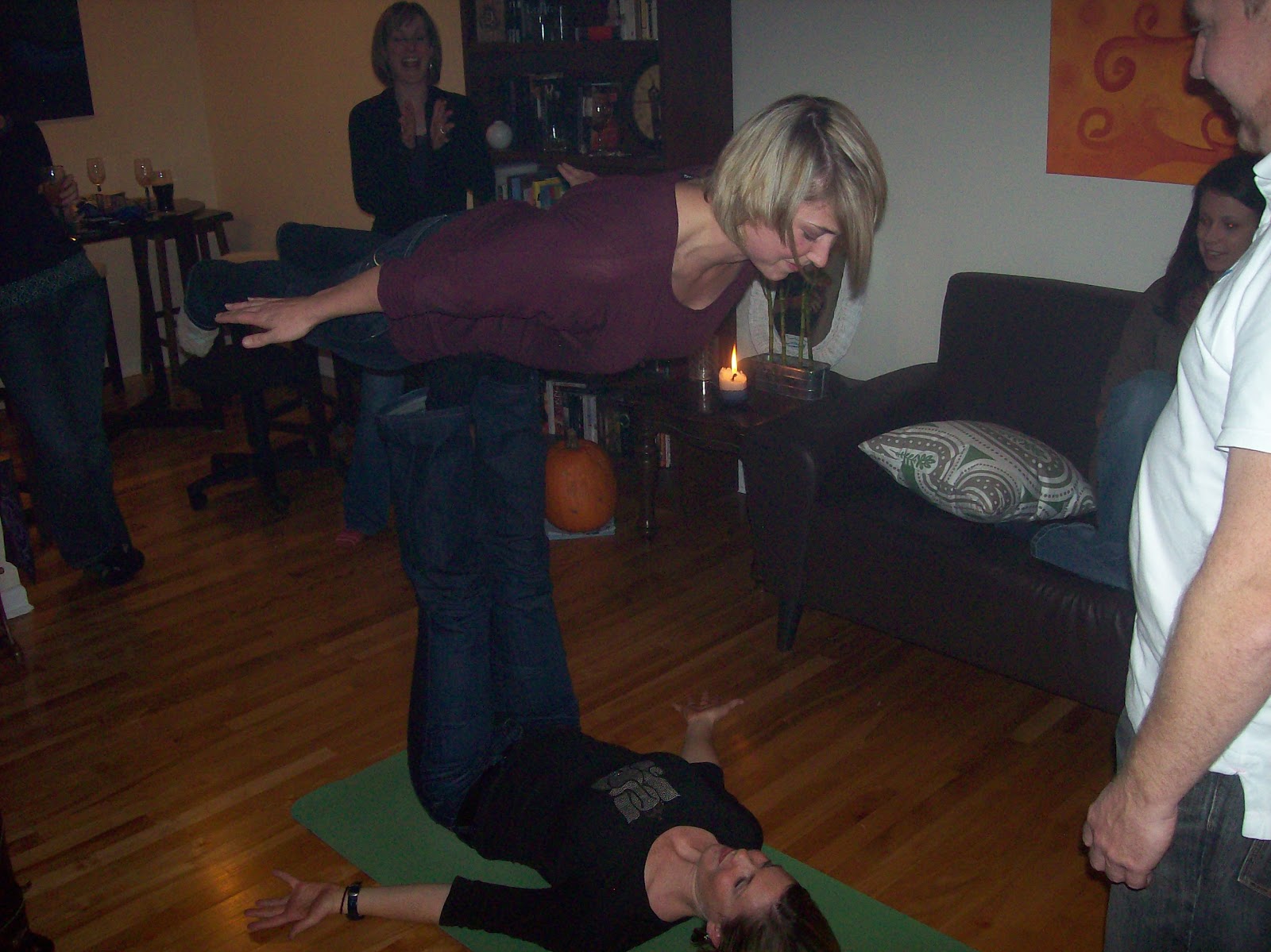
Acro Yoga at our old apartment a few years ago! (that is not me flying, I'm clapping in the background lol)
 
This is especially important if you've already started to consider how to lower your environmental footprint, because a lot of "next steps" involve DIY, homemade, reusing and ultimately fixing. Things like canning and bread making go better if they come with certain kitchen gadgets. Except, who has the money for a food processor? Or room for a complete canning set up? And who has a root cellar to store all this crap?

Either we don't have any of the tools, or we each own one of everything ourselves. Which is a little silly, why do we each need to own something we use infrequently?

A more efficient (and money saving) idea would be to cooperate with other people and share our tools and resources. Some fabulous ideas on how to share resources and skills:

A tool/gadget sharing system
You want to make some bread but don't have a stand mixer? I want to make some sort of pesto but don't have a food processor? How about a trade! Trading and sharing could go as far as sewing machines, drills, building tools, gardening tools... for gadgets that we don't use every day, sharing can be an excellent money and space saving solution.

A product/tool bartering system
This is something that our group of friends does already. Our friends have a food processor and make basil pesto (frozen in individual containers) every year. This week Andrew made four loaves of bread with the stand mixer and we traded pesto for bread. It doesn't always work on an immediate 1:1 level. If you're pretty confident in the eventual exchange, you could always drop off your goods when they're done. We also lend out our electric drill to friends and have used their caulking doodad for the tub.

Sharing a community space
This could be a garden or a root cellar. This would involve having a group of people meet, agree upon a shared space and splitting the cost and upkeep together. I'd say it involves a bit more organization and commitment as well as a certain level of relationship with members. It would also be a bit more difficult to organize and get together in a city, unless you have friends who have space for a garden or root cellar.

A resource/tool library
I really like this idea, although I do think it would be the most time and organizational intensive activity. Splitting the responsibility of care between community members can get a little hairy, as most people will expect one person to take on the lead role here. Some ideas to make it work: either having the tools in one spot (like a garage or shed with a special code to access) and sign out sheet, or having an online list of tools and contact info for the group.

All these ideas are fab, but you need to be able to actually connect with your neighbours in order for cooperation and sharing to be even a possibility. How many of us actually know our neighbours? Alex's suggestions were a little bit much, as he recommended that a person hand out flyers door to door for a "block" resource library meeting. I'm not sure about you, but I know if I went door to door even in my own building handing out little paper invitations, my neighbours would think I was a bonkers hippie.

If this idea of community, connection and sharing interests you but you have absolutely no compunction to be handing out recycled paper invitations to complete strangers, here are some alternatives:

How to build a community in a city:

1. Introduce yourself to your neighbours. Seriously. I know it feels weird and we all live separately in our small little square boxes next to each other, but it's time to make life interconnected. While living in Montreal my roommate (colloc!) at the time strongly warned me against introducing myself to my neighbours ("They could be crazy! Montreal is filled with crazy people, do NOT introduce yourself!). So for two years I didn't even meet my neighbours. If I were dying of something I wouldn't even be able to knock on their doors for help.

Some ideas for introducing yourself to your neighbours without appearing like a complete weirdo:
- If you just moved in, bake something and bring a few of them over. I know it's kinda cliche'd, but people like cookies and often respond positively to baked goods. Also, just moving in is a perfectly acceptable reason to introduce yourself. It also is a great way to assure that if your neighbour's have complaints (noise, or people over) they'll come to you before complaining to the landlord. (yes I am smart).
- Even if you've lived there for a million years, bake stuff and bring it over. Yes, still will be slightly weird, but like I said people really like cookies.
- don't bake? Buy some local baked goods and bring them over. Fake it.
- At a holiday, get cards and maybe a few chocolates for your neighbours. Ya know, nothing too weird, but enough to give you a reason to knock and say "hi"!

2. Recognize that community and relationships take time, especially with a group of people you don't intend to befriend or make an immediate full fledged friendship (unless you plan on stalking them, which would be creepy).

3. When you do see your neighbours, say "hi", ask them how it's going... ya know- CONNECT.

4. Join a local community book club or hobby activity. Mostly likely these people will live near you and share some of your interests, making it easier to connect with them and build in ideas.

5. Once you have a baseline, start inviting your neighbours to events. BBQ-ing (or "Grilling" as I was informed while staying in Florida years ago)? Invite a few neighbours over. Going to Yoga in the Park and you know your neighbour practices? Invite them along. Baked a whole crap ton of cookies? Bring over the extras. It starts the idea of sharing and will help you determine who might be more open to the idea.

6. Planting a garden on your balcony? Let your neighbours know. With the person below you, it can be the excuse that you wanted to let them know in case you ever water onto their balcony by accident. You could casually throw in a "if you ever need any extra _insert copiously grown vegetable_ just let me know!".

We're attempting to guerrilla garden (once it stops raining) on our roof, which equals climbing up the emergency fire escape. Today I asked our upstairs neighbour if he minded, and made sure to mention that if he ever wanted some lettuce to just help himself.

7. If you feel fairly secure in your neighbour connections, but haven't considered how to broach the idea of a resource sharing concept: why not knock on doors (or email) and ask if you could all meet up and chat about it.

8. This could easily work in a yoga studio. Bartering is already often used with regards to cleaning, but what about other means of yoga class-skill exchange. It's also the perfect space to organize and create community meetings and meetups to chat about sustainable practices, resource sharing and forge new yoga-munity connections among the students.

Living isolating, parallel lives has been eroding our feeling of responsibility, social connection and support networks that we need in order to feel empowered.

Cooperation and community=Yoga.

article copyright of EcoYogini at ecoyogini.blogspot.com

Wednesday, May 18, 2011

Permaculture- it's not just about dirt and gardening

Spontaneous permaculture talks. I mean- what else could be more titillating? Do we live on the wild side or what?

You may be asking (as I did): 'What the eff is permaculture?'

Well... honestly if the talk were any indication, besides something that radical hippies/hipsters (hey, not that I'm not a tree hugger myself, I just happen to own a fridge) buy into, permaculture has something to do with agriculture. Permanent Agriculture is a term that has grown into, over time, "Permaculture".

Clear right? (Let's just say that the presenter wasn't the best at clearly defining topic and explaining the "what" in "What is permaculture").

Ok, so it's actually a lot more than simply a closed loop, sustainable agricultural system... which is what I originally thought permaculture to be. A quick search on wiki reveals that modern permaculture is:

...a system design tool. It is a way of:
  1. looking at a whole system or problem;
  2. observing how the parts relate;
  3. planning to mend sick systems by applying ideas learned from long-term sustainable working systems;
  4. seeing connections between key parts.... (wiki source)
(interested? More info on permaculture at Permaculture Principles)

A friend of mine had informed me that morning that the talk was occurring at a tiny bookstore-cafe two seconds from where we live (The Trident). As we'd never been there before, and hey I like ecological topics, we decided to attend. First of all, being type A, it was a little stressful to discover that the time was a little fouffy, no one (even the staff at Trident) really knew when it was starting and seating was haphazardly assigned. I had a few deep breath moments.

The presenter was an experienced and obviously passionate farmer, Alex. He had a beautifully hand drawn "Permaculture Flower" taped up against the book shelves and I could still see the soil beneath his fingers. Although there were a few key aspects of his presentation that were a bit wonky (ridiculously poor organizational and explanation skills and some obvious biases against all government and traditional educational settings, and several conspiracy theories thrown in for good measure), Alex reminded me of a few key and inspirational Eco-Musts.

Firstly, to my surprise, he did not in fact begin talking about soil, plants or compost- but Peak Oil. Nothing new here- oil sequestered by the sun for millions of years is a finite resource, we're chewing through it at something like 80-something million barrels a day and have passed the point of the peak amount of oil available on our planet. It is something to consider, because unless we start investing in something else for energy, our fuel costs will just continue to skyrocket in the long term.

As I sat there, surrounded by large framed glasses wearing, huge beard and "trying to look authentically like a trucker hat even though I obviously have never lived outside the city my entire life" wearing early twenty somethings who chimed in at the end how "parents are the WORSE man", I kinda felt a bit out of touch. Ya know, I have visual evidence of me hugging a ginormous tree in Stanley Park (Vancouver BC), and truly have grown up in rural Nova Scotia where I'd come home regularly to a new deer gutted and hung up in my grandpy's barn to be shared with everyone, but I kept having moments of "please give me something practical and useful hear" instead of Mr. Alex's passionate advice to build a rocket stove or a root cellar.

I kept picturing Andrew and I attempting to cook grilled cheeses in a brick makeshift stove with the fire started by the twigs we gathered and an increasingly large black burned area in our living room floor. I figured it would be 5 minutes before our neighbours would call the fire station... and we'd get evicted.

After the first hour I had a harder time tracking his jumping bean train of thought and connecting all the dots. I found myself gazing lovingly at the beautiful Permaculture Flower.


Now this flower has some interesting community and life implications. 

It looks an awful lot like a pagan diagram. The spiral, the connection with nature and the ethical concept that we're here to care for our planet as stewards.  I wondered on the Goddess or probably pagan roots and connections. There is definitely something spiritual connected here.

At 9pm my face was so red, my heart and mind a bit heavy after such a long, disjointed and impassioned speech (we'd been there since 6:30pm), that I was very much happy to go. Even though I really wanted to directly challenge a few of his statements (that university brainwashes you, that parents and the baby boomers know nothing about conservation, that environmental organizations really don't do squat, that urban gardening is a waste of time, that cooperation and community has been lost in rural and urban settings alike...), I just got up and left. The thing is though, I'm fairly certain he would have listened respectfully and been a great conversation partner.

Ahh well- the following post on cooperation and community: why it's important to begin thinking about and how to start one in your living area, were worth the entirety of that 2+hour talk. :) That and it was so moving to see someone completely passionate and caring share his thoughts and ideas.

The one book I've read that mentions permaculture? The Earth Path by Starhawk. An amazing book btw that teaches you how to make seedbombs. Oh yeah.


article copyright of EcoYogini at ecoyogini.blogspot.com

Monday, May 16, 2011

A little case of flower kleptomania

I adore flowers. Growing up, in little tiny, population 500, rural Nova Scotia, basically all flowers were free for the picking. Seriously. Well- except for lady slippers, as they're endangered... At the age of 3(ish) I picked one at Ellenwood Park cuz it was pretty. Sadly the Park Ranger (or whatever they're called here in Nova Scotia) saw and yelled at my little preschool self. It was traumatizing.

 Me frantically picking mayflowers...
Ok, so obviously I may have had this weird preconception that flowers are free for everyone since birth. Being able to pick anyone's flowers wherever I went also didn't quite help curb this urge.

 Yay flowers!!!
I think I just realized that maybe this might be a problem. Even after moving to various cities my urge to pick flowers didn't abate. It was like living in a city, which would obviously entail different social rules regarding property of nature since, didn't phase me. I'm pretty sure I randomly picked flowers throughout my undergrad in Fredericton.

While living in Montreal there were a few evenings walking (ok stumbling and giggling) home with friends that I would stoop by newly planted flowers and do a walk-and-grab, roots and all. I planted the pretty white flowers on my balcony and no one knew any better.

In Saint John it was a middle of the day walk-and-grab. Andrew was a bit traumatized. I reasoned that it was a government building, so technically we paid for the flowers anyway. I planted those too.

Every time we go to the Farmer's Market I just can't bring myself to actually PAY for flowers. I mean, what a silly expense, I could just go PICK some (where, I have no idea).

In the past few weeks Halifax has been filled with the most beautiful tulips. They are everywhere! Taunting me with their beauty and the fact that I'd probably get in trouble if I JUST PICKED ONE.

Ok, I am officially a weirdo flowerklepto. Officially.


article copyright of EcoYogini at ecoyogini.blogspot.com

Saturday, May 14, 2011

My Guilty Yoga Secret...

Since Winter my yoga practice has been leaving me feeling empty. I've soldered onward, practicing about once or twice a week. I've had a few amazing practices, but instead of weekly discovering new sequences or being inspired by new asanas and teachings, I've just grown increasingly disenchanted.

It's almost embarrassing to admit, but it feels like I've been carrying around this terrible dirty secret from everyone the past six months or so. I don't worship yoga anymore, it's not something I want to do every single day anymore. I'm glad I didn't take Yoga Teacher Training, mostly because I don't agree with so many aspects of the training here in Halifax. It's no longer the centre pathway to connect with my concept of the Divine.

Not to be all whiny, but I miss yoga. I do. It's like my body and heart knows there's something missing (tu me manques!), but I can't seem to motivate myself to get off my butt and practice. Yogaglo no longer holds as much appeal. I've started resenting and have become jealous of those yogis I see walking down the street with their yoga mats, going or returning from a yoga class. How dare they love yoga? How dare they afford the 18$ a pop classes?? BOO THEM (lol, my little tantrum is usually internal... and probably makes me officially 2 years old).

I can't believe I used to secretly judge those people who call themselves 'yogis' and never practice (even if it really was just minutely, I swear). I haven't practiced yoga since Montréal... which was over two weeks ago. Yesterday, instead of choosing to practice yoga, I chose to play some guitar. It was either one or the other.

In about 35 minutes I'm putting on my yoga clothes, rolling out my mat and will try to find a fast moving, mind numbing practice to try to beat the practice back into my Self. Hah, I know, kinda sounds counter-intuitive, but there ya go. I'm going to try setting aside a 20 minute practice three days a week to see if by sheer repetition, regardless of whether I want to or not, yoga will reconnect.

I'm also hoping for yoga in the park to save my practice. I'm so friggin' tired of practicing in my living room. We haven't had a sunny weekend warm enough to practice since Easter weekend. And Andrew and I were home with my parents visiting.

So sorry guys for the downer post. Anyone else out there share this dirty secret?


Blessings

article copyright of EcoYogini at ecoyogini.blogspot.com

Monday, May 9, 2011

Fish-A-Tarians: Eco-Tips for Eating Fish

Are you a flexitarian, omnivore, vegetarian+fish? I grew up around fish, I adore mussels, haddock, halibut and lobster. It would be difficult not to, living in a province like Nova Scotia, surrounded by the Atlantic Ocean except for a tiny little bit of land connecting us to New Brunswick.

If you are a fish eater, there's a couple of things to keep in mind in order to assure the fish you eat nourishes yourself, the planet and the local economy- all at once!

General fishy tips:
  1. Consider where you live. How far away is the ocean from you? Cuz that's how far that salt-water fish filet has traveled... 'Fresh' really is relative. For example, I was shocked that most restaurants in the interior of British Columbia actually sold 'Atlantic' mussels, proudly displaying they were from PEI. Now... take a quick look at the map to see just how far they traveled (over 6000 km!). Pair that with the fact that BC actually has some pretty yummy pacific mussels... wtf?
  2. Try to keep it to your coast. Atlantic gal? Support Atlantic fish. The closer the fish exited the water, the fresher it will be, the better it will taste and you're putting your money right back in your community.
  3. Don't have an ocean near you? Maybe you should consider purchasing fresh water fish, or leaving salt water sustainably fished filets for the special treats.
  4. Frozen really doesn't taste better. If you're visiting an ocean-y spot and your only experience was frozen fish, please give fresh fish a try. You'd be shocked just how yummy it can be.
Pacific sustainable fish (according to SeaChoice and Mr. David Suzuki)
  1. Sablefish: Pacific or Alaska that are trap or bottom longline caught. Avoid: Trawl caught or bottom longline from Washington, California and Oregon. Sablefish have been known to live up to 113 years! Check out Mr. Suzuki's site for recipes and more fishing info.
  2. Spot Prawns: Caught in Canadian Pacific by trap. Avoid: Spot Prawns caught in the U.S. or Tiger Prawns. Yummy recipes and fishing info!
  3. Sardines: Canadian or US Pacific- purse seine caught. Avoid: Atlantic (US & Canada) caught by mid-water trawl or purse seine. As icky as I find them, lots of people like sardines... so sardine lovers check out this extra info!
  4. Albacore Tuna: caught by troll or pole in Canadian and US Pacific waters. Avoid: caught by pelagic longline. They can swim up to 80 km/h! Dr. Suzuki definitely has some great tips!
  5. Dungeness Crab: trap caught in Canada, Oregon and Washington. Avoid: trap caught in Atlantic Canada or Alaska. These lovey-crabs embrace for several days during mating. More racy info here!
  6. Pacific Cod: Caught in Alaska by bottom longline, jig or trap. Avoid: Atlantic or Pacific waters other than Alaska. These babies are like rabbits; one female can spawn up to 5 million eggs per birthing! wow. More info right over here.
Some Atlantic Fishies (Mr Suzuki really isn't that helpful here):
  1. Haddock: If you live in Nova Scotia you have access to "Off the Hook" CSF (Community Supported Fisheries) where haddock (and hake and pollock) are caught by bottom hook and line: sustainable and a bit more pricey (but worth it!). Make sure you look for hook and line haddock for the best choice. Otherwise it's "dragger" caught which trawls on the bottom of the ocean tearing up our ocean floors and catching so many other fish in their nets as byproducts. See my recipe below for fool-proof delicious haddock!
  2. Bass/Striped: look for hook and line striped bass.
  3. Lobster: Mmmmm. As most lobster in Canada and the US is caught in Nova Scotia and Maine, the closer you are to these two places the better. American? Look for the "Caught in Maine" tag that has been implemented to avoid Maine buyers purchasing Nova Scotian lobsters and selling them as "Maine" lobsters. (yep, that happened!). Check out my Lobster post on some details of lobster fishing and the comment section for further insight.
  4. Northern Shrimp: Look for coldwater trap caught. Avoid warm water farmed or wild.
  5. Swordfish: harpoon caught. Avoid harpoon caught in the Indian Ocean, Mediterranean, International Atlantic and Pacific Oceans: management and numbers are not as good as they are in Canada. This is some crazy kind of fishing. My brother spent a few summers, it involves weeks on the ocean with waves that rival the boat itself. Cahones.
Worldwide:
  1. Farmed oysters: look for suspended culture systems. Avoid wild oysters caught by scallop or dredging. Oysters a like miniature water filters and uber sensitive to coastal pollution.
  2. Closed Containment Farmed Salmon: Avoid farmed salmon raised in open net pens. Closed containment takes care of many of the threats posed by farmed salmon on the wild population!
  3. Farmed clams: or wild clams hand raked in the US. These pretties help absorb carbon dioxide by absorbing it in their shells. Neat!
  4. Farmed Mussels: mmmm. I have discovered that the best way to eat mussels are the spicy/curry style. Way better than butter and wine. Trust me.
If I didn't name one of your fav fishies- check out SeaChoice and give'er a search!

Lisa's Yummy Jammy Haddock:
Two hook and line caught fresh non-frozen (if possible) filets.
1 jar of "hot pepper jam" (Haligonians, Pat's Preserves Hot Pepper Jelly is Delicious! Available at the SeaPort Farmer's Market).

Pre-heat oven to 400 degrees F
Place filets in a glass casserole dish. Empty the Hot Pepper Jelly on top of filets. 

Cook for 10 minutes ONLY.

That's it! You should have delicious, moist perfectly cooked haddock with a little bit of a kick!


Lisa's Tips on Cooking Lobsters:
  • Steam in a ginormous pot with only a couple of inches of water.
  • Add enough sea salt (or regular salt) to make the water taste like ocean water. Trust me, the lobsters will taste better because of it.
  • Please steam them live... killing them prior to steaming could release some random toxin and make the meat inedible. The myth of lobsters screaming? A myth. I would know, I've had lobsters at home my entire life. Seriously, we used to race them on the kitchen floor.
  • Invest in some sort of cracking mechanism for the shucking. Or a very nice large knife. There's a sweet spot on the claws (mid claw) that with a good whack and a slight wrist twist you should be able to open them.
  • A mason jar is the perfect tool for rolling out the yummy yummy legs. My favourite part!
  • Only crazies eat the TomAlly... or fishermen. 
  • With the tail in one hand, facing up and a fork in the other, facing down, go in and pull the meat out. Make sure to peel the outer part off and clean out the poop trail. No one wants to eat slices with a little surprise of poo in the middle. Ew.

Lobster chowder including only lobster meat (fried in a pan w butter and garlic post steaming) and potatoes (boiled in small chopped bits) adding cream or milk and butter is the best way to enjoy lobster IMHO. Shucking is just tourist-y and way too much work. :)

How about it? Any fish-a-tarians out there?

Blessings!


article copyright of EcoYogini at ecoyogini.blogspot.com

Saturday, May 7, 2011

Why paying more for gas makes me happy

My time in Montréal reminded me of life pre-car. That city, with the métro and bicycle lanes and Bixi's is just so well set up for non-auto living.

Halifax, (and my job) on the other hand is not.

Recently the price of gas has sky-rocketed here in Nova Scotia. Currently it's a 1.37$ a litre (not sure what that would be in gallons). In Montréal last week it was 1.44$.

As backwards as this may sound, I am so for increase in the price of gas and oil. I'm hoping (as I'm not an official economic oil-gas-environment analyst person) it will mean:

  1. People who really don't give two rats-bums about the environment (who ARE they anyways?) will purchase smaller, more fuel efficient cars because of the price of fuel.
  2. These same people will also hopefully drive less, walk more and consider public transit.
  3. Regular people who DO care about the environment (yay us!) but may have an efficient vehicle will walk more, drive less and take public transit (or bicycle!).
  4. As more people are interested in fuel efficient cars- car companies will promote and invest research in creation and production of zero-emission vehicles.
  5. As more people in Halifax who are business class consider and take public transit, they will demand more efficient transit systems. This will increase investment in public transit making it more convenient than driving and as a result encouraging more people to give it a go.
  6. Cost for food transportation will increase, resulting in companies finding more efficient ways to transport food. The price of food being shipped in from all four corners of the planet will increase.
  7. Food that comes from thousands of miles away will become more comparable in cost to locally produced food (hopefully), as locally produced food won't be paying the same level of shipping costs. 
  8. As cost balances out, more people will consider purchasing locally grown food.
  9. Cost for heating will increase, motivating people to conserve heat, insulate their homes or consider alternative heating options like solar.
  10. Bigger businesses who actually have a huge impact on the environment will consider more environmentally friendly practices as the cost of energy intensive production continues to rise (and not because they really give a poop about the environment).
So there ya have it. My top ten reasons why a rise in price of gas and oil actually makes me happy.

What do you think? Any official oil-gas-environment analysts out there?


article copyright of EcoYogini at ecoyogini.blogspot.com

Monday, May 2, 2011

A trip to my favourite Canadian city

I heart Montréal- just spent Wednesday to Sunday enjoying fascinating sessions on bilingual and francophone language development and sharing the city I loved for two years with Andrew.

Here are some highlights of our trip! (warning- lots of pictures!)

 Bixi's! Montréal is in her second year of 'rentable' bicycles. Andrew fell in LOVE with the idea and will be writing a guest post soon on the whole topic.
 This is an example of the excellent bicycle lanes- see the poles? They separate the bicycle lanes from cars to assure no one, say, parks or drives in the bicycle lanes.
 How I missed the métro. Seriously. SO convenient and easy to use. Also, since I left they finished a few extra stations and the orange line now ends with 'Montmorency' and not 'Henri-Bourassa'. Weird.
 Our first place to visit was Vieux Montréal. The buildings are so beautiful and historic (right). I then dragged Andrew up to des Pins to see good ole 'Beatty Hall' (left) where I spent my entire Master's. Surprisingly, Lilly, admin, still remembered my name after five years! The picture directly above is a good example of the townhouses in my old neighbourhood on St Joseph.


 I discovered Katrin Leblond's wonderful, hand made, sustainable clothing boutique. And bought fun hand felted and recycled copper earrings and one of her beautifully hand sewn organic cotton dresses. Yay!

 Saw this TINY yoga studio sign- Ahimsa Yoga and had to snap a picture- Eco Yoga anyone? Funnily enough, I met the owner about an hour later- and she even recognized me as 'Eco Yogini'!! We got to visit her studio and it is GORGEOUS. Wish I could have practiced there!

 An exciting moment was when I got to meet Roseanne, former 'Its all yoga, baby' blogger extraordinaire. It was so amazing to get to meet her in real life. She's hilarious, clever and well... just like her blog only better! The space, le cagibi, was so cute and incredibly 'Montréal'. Also filled with hilarious roller derby-ers with jersey's that said 'The Silencer' and 'Dolly Parts'em'.

 Andrew and I losing our Vegan Virginity at 'Aux vivres': an amazing Vegan restaurant. Now, we may not be converted, but it was a fantastic Montréal experience! I ate a Buddha Bowl, and he had a Garden Burger. Mine was fabulous, but let's just say Andrew still loves beef-made burgers (hah, he said 'It's not terrible' which is high praise for carnivorous Andrew).
Our last day in Montréal we met friends for brunch at Les Entretiens. It was a fun meal filled with yummy crêpes (pomme, noix et brie) in a space with First Nations Art on the wall, a baby grand piano with a jazz pianist on the right with delicious mocha in a BOWL. As you can see, Andrew is experiencing coffee in a bowl as you can only in Montréal.